


One of the biggest risks in moments of change isn’t the change itself. It’s the gap between when the impact lands and when organizations are able to respond.
With the November midterm elections approaching in the United States, mission-driven organizations are preparing for another period of uncertainty. The months ahead could bring another wave of change with shifting priorities and budgets, revised regulations, and agencies tasked with rethinking how programs are run. The past two years have already shown how quickly the landscape can change: funding streams paused, eligibility requirements changed who can access benefits and services, and tariffs increased prices within days.
Each of these shifts directly impacted people, often before they fully understood what was happening or what it meant for them.
When policies, priorities, or programs change, mission-driven organizations can help communities understand what has changed, navigate other options, and stay connected to the support they need. But their ability to respond in that moment depends largely on whether they have the capacity to adapt.
What makes an organization adaptable?
Mission-driven organizations often operate within tight constraints. Their budgets and programs are built around existing priorities, funding requirements limit where resources can go, and staff may already be stretched to meet demand. Even organizations that deeply understand their communities’ needs may struggle to redirect time, money, or people right away.
Organizations that navigate change most effectively are those that have invested in flexibility before they need it. That might mean knowing which funds can be redirected and when, cross-training staff, maintaining partnerships before they’re needed, or having reliable data that shows who will be affected. Together, these investments build an organization’s flexible operating capacity: the room it has to maneuver when circumstances change.
Flexible operating capacity is not a single lever. It can be:
- Financial - funding that can be moved as needs change rather than locked into a single activity.
- Operational - staff with the time and skills to shift priorities when circumstances require it.
- Relational - partnerships built before a disruption that can be activated quickly.
- Informational - systems that help organizations understand what is changing and who is affected.
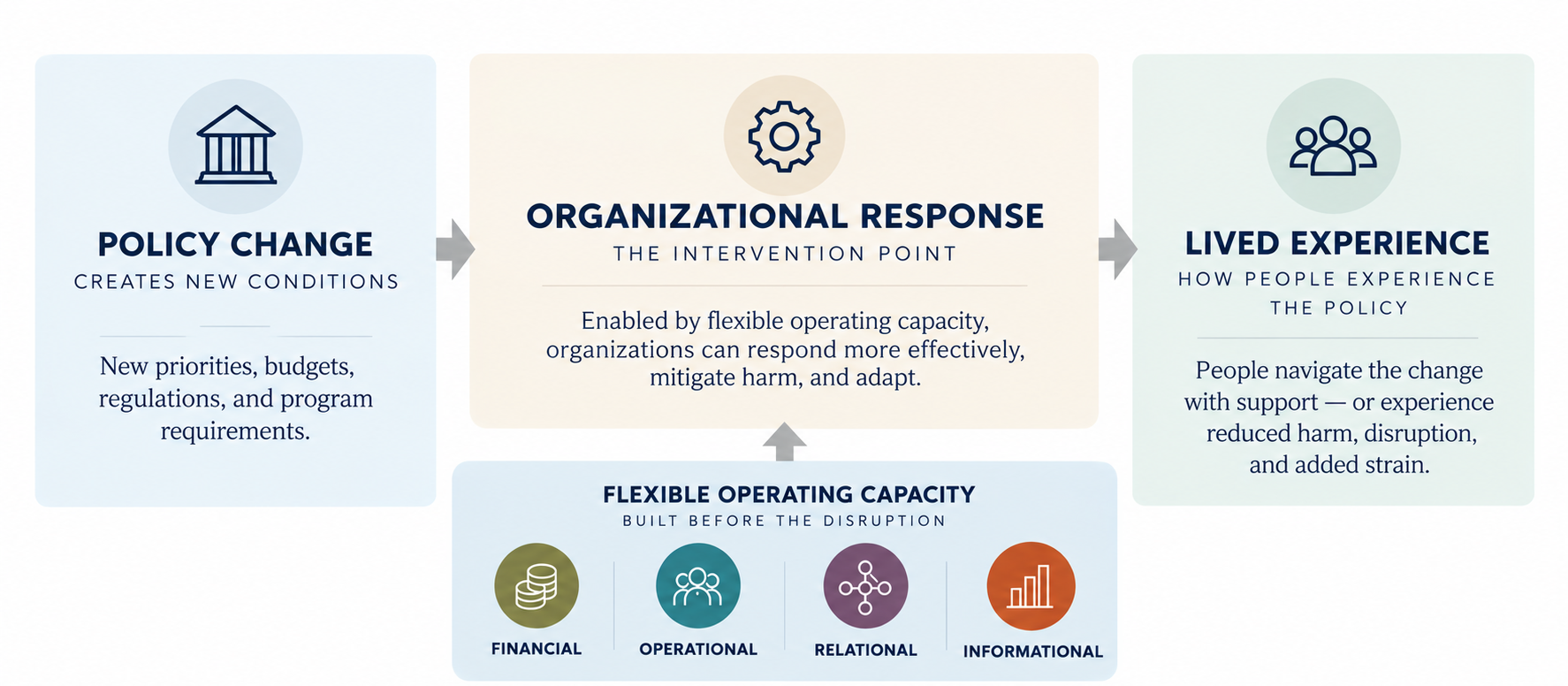
When these forms of capacity exist, organizations can absorb the shock of a policy change before it reaches the people they serve. When they don’t, that gap doesn't disappear; it is transferred elsewhere. It moves first to frontline staff, who take on navigation, outreach, and paperwork on top of full caseloads. It moves to community partners, such as food banks, clinics, and mutual aid groups, which stretch already thin resources to cover gaps they didn’t create. And ultimately, it moves to the people the policy affects, resulting in longer waits, missed deadlines, lost benefits, and hours spent trying to make sense of a complicated system.
These costs rarely show up on a budget line. They show up as burnout, strained partnerships, or beneficiaries who lost support because information didn’t reach them in time. Adaptability shapes not only how effectively an organization responds, but where the cost of a policy change lands and how deeply it is felt.
What does adaptability look like in practice?
We saw this firsthand in our work with MidPen Housing, an affordable housing nonprofit that serves nearly 22,000 residents across 12 counties in Northern California. In 2026, federal changes to SNAP began reshaping CalFresh eligibility, changing the landscape of food access for residents. MidPen needed to quickly understand the implications for residents and equip staff to help them navigate the changes.
Rather than building a response from scratch, MidPen drew on existing capacity to mobilize support. Existing data systems allowed MidPen to identify which and how many residents were likely to be affected and where. Leaders reassigned staff to serve as navigation leads. Trusted partnerships with local food banks were activated to develop communication materials to inform residents of the changes and implications for them. Together, these steps allowed MidPen to mobilize a coordinated response quickly enough to ensure that residents received the information and support they needed before confusion or delays created lasting consequences.
“The lived experience of our residents is always front and center in our decision-making,” shared Brenda Castillo-Garza, Senior Vice President and Head of MidPen Resident Services.
“When unexpected changes affect access to essential benefits, the impact can be deeply destabilizing for families. Our ability to respond quickly meant we could get residents timely, relevant information to support their agency in making informed choices about what came next.”
MidPen’s experience shows that adaptability isn’t necessarily about having resources sitting idle. It’s about having relationships, systems, and decision-making flexibility to put existing resources to work differently when circumstances demand it. What’s notable about MidPen’s response was their ability to activate several different channels at once.
How to position your organization to act quickly?
Building adaptability doesn’t always require new systems or resources. It often starts with choices about how existing resources, relationships, and decisions are managed. Moments of transition, when new priorities are still taking shape, are a good time to take stock. A few approaches to support adaptability:
- Know who you serve with enough detail to act. MidPen could move quickly because it had data mechanisms to identify affected residents. Create data systems to answer how communities would be affected in light of policy changes.
- Assign someone to monitor the landscape. Give a person or team a clear responsibility to track policy and funding developments and translate into what it means for your community.
- Cross-train staff. An organization with cross-trained employees can move people into new roles and responsibilities within days. One without flexibility may have to hire, train, or simply do without while needs grow.
- Decide in advance who has authority. Agree on who can redirect staff time or funding to avoid waiting on multi-layered approvals.
- Formalize partnerships and maintain them. Relationships built during stable periods can be activated more quickly than starting from scratch during a crisis.
- Listen to the frontline. Create regular, low-burden ways for frontline staff to share emerging insights about beneficiaries. They often see the impact of a change first.
For leaders, building flexible operating capacity begins with an honest assessment of where the organization has the least room to maneuver:
- Which budgets, roles, systems or programs would struggle to adapt if circumstances changed tomorrow?
- Where are decisions concentrated?
- Which relationships are essential but underdeveloped?
- What information would leaders need in order to respond quickly and confidently?
Adaptability is also shaped by the people who oversee and fund an organization. In a stable environment, lean staffing and tight budgets can look like good management, but they leave little room to respond when circumstances change. Boards can support by approving a reserve set aside for rapid response, giving leadership pre-approved authority to redirect staff or funds in an emergency, and making scenario planning a regular part of their oversight. Funders can help by providing general operating support and recognizing that some flexibility in a budget is not an inefficiency. It is what allows an organization to absorb a shock without passing its costs to staff, partners, or the people it serves.
No organization can predict every legislative, regulatory, funding, or administrative change the future may bring. What it can do is create enough room to move when change arrives. That room—financial, operational, relational, informational—is often the difference between people navigating a policy change and people falling through the cracks it can create.


