


In 2025, I reflected for the Global Washington community on lessons we can take from past global health innovations and apply to AI implementation (you can read that post here). I argued that while AI holds real promise for our field, its impact would depend less on the technology itself and more on how it is applied—whether it strengthens existing systems, addresses real-world needs, and avoids repeating common pitfalls from past innovations.
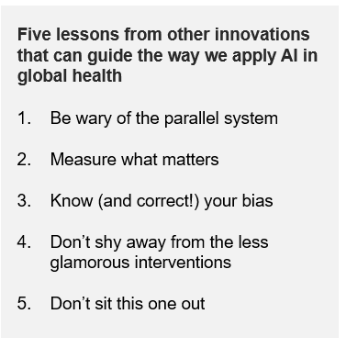
One year later, those lessons feel even more relevant. Across global health implementers, convenings, and the broader social impact community, there is continued excitement about what AI can do to expand access to care and improve health outcomes, alongside a growing focus on how to make it work in practice.
In our work at Panorama, we’ve had the opportunity to engage with and learn from a number of organizations that are successfully applying AI to improve health outcomes. What stands out is not just the innovations themselves, but how they are being implemented in real-world settings.
Looking across these efforts, a few distinct patterns emerge, offering a clearer picture of what it takes to apply these lessons in practice.
Working within existing systems: Supporting frontline care
ARMMAN is an NGO in India that works to reduce maternal and child mortality and morbidity, in part by strengthening the capacity of frontline health workers. In recent work, they have piloted an AI-enabled WhatsApp assistant to support Auxiliary Nurse Midwives (ANMs) in identifying, managing, and referring high-risk pregnancies. The tool provides timely guidance directly at the point of care by answering the ANMs’ questions about high-risk conditions and quality antenatal care.
Recognizing that safety is paramount, the chatbot pulls answers from clinically-validated training protocols and, if the question is out of scope or if the ANM is not satisfied with the chatbot’s response, the question is escalated to a medical trainer (the human-in-the-loop). The chatbot offers multilingual support in Hindi, Telugu, and Marathi through both text and voice. The chatbot’s answers are designed to be crisp and actionable, with the body of the answer in the local language and medical terms and numbers in English. Over 7,800 ANMs are now using the chatbot, generating more than 30,000 queries to date, with over 97% of responses receiving positive user feedback.
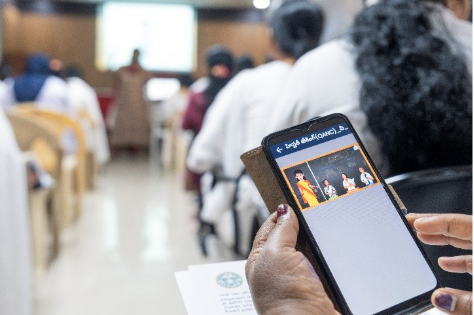
This example illustrates what it looks like to integrate AI directly into existing health system workflows. Rather than introducing a separate platform or parallel process, the AI-enabled assistant is embedded in tools that health workers already use. This allows providers to access critical support in real time, enabling early identification of high-risk pregnancies and timely referral to care without requiring additional steps or time that frontline providers often cannot afford.
ARMMAN’s approach reflects a core lesson from past global health innovations: solutions are far more likely to succeed when they strengthen existing systems rather than operate separately from them. It also highlights the importance of building on existing technologies that are already widely used and trusted, making adoption more feasible in real-world settings.
Building for scale: Coordinating technology, systems, and care delivery
Butterfly Network is a digital health company working to expand access to diagnostic imaging through handheld, AI-enabled ultrasound devices. While the technology itself is innovative, what is equally notable is how Butterfly approaches implementation in global health settings.
Butterfly works with governments, NGOs, and health systems to support end-to-end deployment, including integrating ultrasound into primary care and maternal health services in low-resource settings. In 2022, Butterfly received support from the Gates Foundation to deploy 1,000 devices to antenatal care providers in rural Kenya and South Africa. Early results showed that access to ultrasound increased uptake of antenatal care, enabled providers to identify high-risk pregnancy conditions, and may contribute to reductions in maternal and neonatal mortality.
Butterfly’s model goes beyond developing technology and distributing devices. It focuses on ensuring that imaging is incorporated into routine care and aligned with existing clinical workflows. This includes supporting provider training, working with health systems to integrate ultrasound into care pathways, and coordinating across partners to enable effective deployment in real-world settings.
“Our approach starts with partnership. By working alongside local clinicians and health systems, we co-develop our technology and workflows to reflect the realities of care delivery on the ground. This ensures that handheld ultrasound is not just introduced as a technology, but integrated as a tool that supports context-specific clinical and referral decisions - ultimately empowering providers to deliver better care within the systems they know best.” — Dr. Sachita Shah, VP Global Health, Butterfly Network
This example highlights what it will take to deploy complex AI-enabled technology at scale. By coordinating technology, systems, and care delivery, Butterfly is not just introducing a new tool but helping to build the conditions required for it to be used effectively across settings. These elements cannot be treated as an afterthought. Success depends on deliberate coordination across sectors from the beginning, bringing together technology developers, health systems, and implementation partners to ensure solutions are integrated and sustained in practice.
Solving problems that matter: Expanding access to trusted information
HelpMum, a Nigeria-based organization focused on improving maternal and child health, has developed a suite of AI-powered tools to address critical gaps in access to health information. This includes VaxAI, a conversational platform that allows caregivers to ask questions about vaccines in their preferred language and receive timely, reliable responses; MamaBot AI, which provides guidance to pregnant women and new mothers; and StratifyAI, which helps frontline health workers identify and prioritize children at risk of missing immunizations. Together, these tools are designed to ensure that the right information reaches the right people at the right time.

As Dr. Abiodun Adereni, CEO of HelpMum, puts it, “We didn’t start with AI. We started with a mother in rural Nigeria who couldn’t get a straight answer about whether her child’s vaccine was safe.”
This example highlights the importance of choosing the right problems to solve with AI. Access to clear, trustworthy health information is one of the most fundamental functions of any health system, yet it remains a persistent gap for many communities. By focusing on this challenge, HelpMum is addressing barriers that directly shape health behaviors and outcomes.
By using AI to overcome barriers such as language, geography, and access, these tools extend the reach of existing services in ways that can be transformative. These tools also demonstrate one important way AI can create impact: by focusing on real-world problems that directly shape health behaviors and outcomes.
So what does it take?
What does it take to make AI work in global health? Funding, technology, and time all matter, but they’re not the whole story. In practice, a few consistent patterns show up across organizations making real progress.
First, successful efforts are designed to integrate into existing systems, not operate in isolation. Whether by building on tools that are already in use or embedding into frontline workflows, adoption depends on meeting health workers and health systems where they are.
Second, progress depends on deliberate coordination across sectors from the beginning. This includes connecting technology, policy, and on-the-ground implementation so that promising tools can move beyond pilots and into sustained use at scale.
And third, impact is also driven by focusing on real-world problems, particularly those that shape how health systems function day to day.
As the field continues to evolve, another consideration is becoming increasingly important: responsible use. Over the past year, there has been growing focus on the need for clear guardrails, including privacy protections, transparency about limitations, and appropriate human oversight. These are not separate from implementation, but essential to ensuring that AI solutions are not only effective in the short term, but sustainably integrated into the health systems they are meant to support.
Ultimately, deep engagement with the health systems these solutions are meant to support is paramount because it is the systems themselves, not individual innovations, that determine long-term success. And because those systems are shaped by many actors, progress requires broad participation. From frontline providers to policymakers, funders, and technologists. The opportunity is already here. Realizing its full potential will take all of us.


